
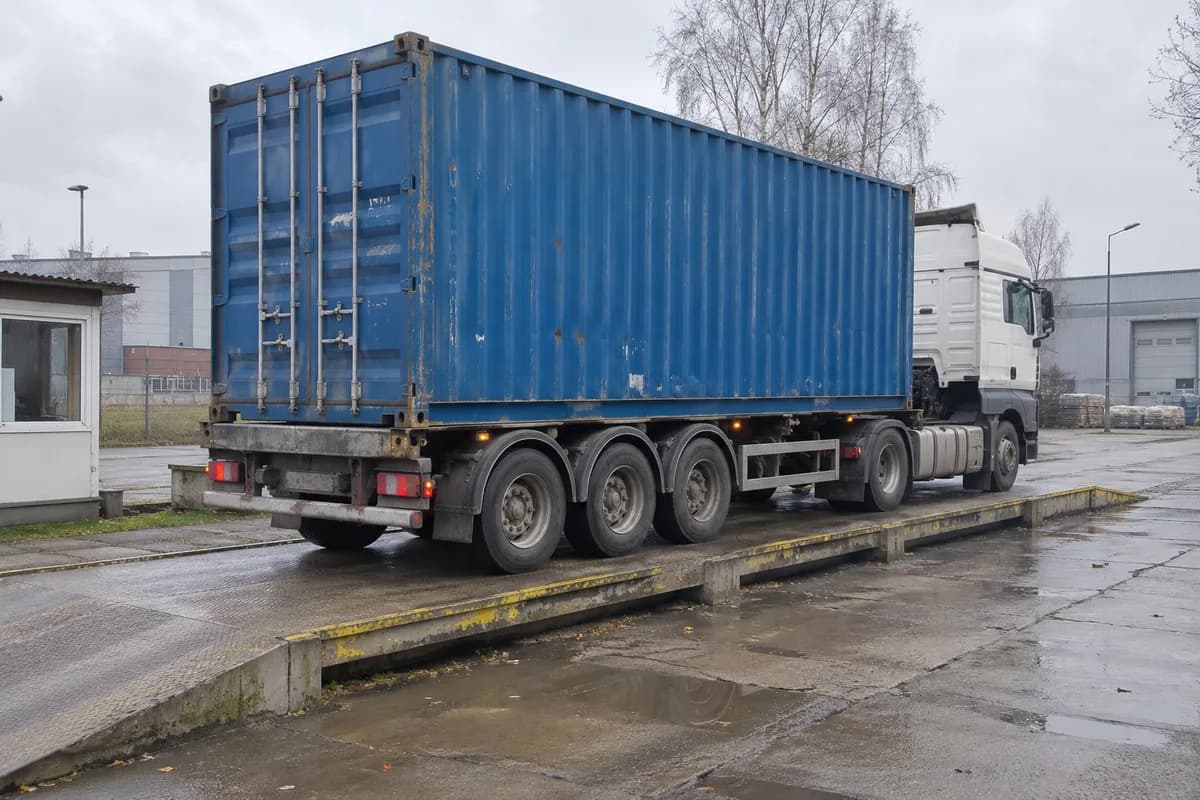
Check shipping container weight before booking transport in Latvia: an empty box and a loaded one may need different equipment. For orientation, the examples below use a tare weight of 2350 kg for a 20ft standard container and 3750 kg for a 40ft standard container. Check the markings on the actual unit for its own weight.
Shipping container weight: tare, cargo and gross mass
Tare is the empty container’s weight. Actual gross mass includes the container and everything loaded into it. Maximum gross mass is the limit the loaded unit must stay within.
Look for these markings on the container doors:
TARE is the empty weight, including permanently installed equipment.
MAX. GROSS is the maximum permitted combined mass of the container and its contents.
NET or PAYLOAD is the allowance obtained by subtracting tare from maximum gross. Packaging and securing materials also use that allowance.
Check maximum gross mass on the CSC safety approval plate as well. Tare and payload markings can be on the doors or rear of the container; they are not necessarily all on the same plate.
Example weights by size and type
These are illustrative container specifications. They do not confirm the specifications of a particular container in Conway stock. Check the selected unit’s markings and documents before loading or moving it. All values are in kilograms. DC means standard dry container, HC means High Cube, and REF means refrigerated container. The payload and gross columns show maximum values.
| Type | Tare, kg | Payload, kg | Gross, kg |
| 20ft DC | 2350 | 28130 | 30480 |
| 40ft DC | 3750 | 28750 | 32500 |
| 40ft HC | 3900 | 28600 | 32500 |
| 45ft HC | 4800 | 27700 | 32500 |
| 20ft REF | 2860 | 29140 | 32000 |
| 40ft HC REF | 4420 | 29580 | 34000 |
Shipping container weight changes with construction and equipment. A reefer has insulation and a refrigeration unit. A converted container may also have lining and fitted equipment. After a conversion, the original tare marking alone cannot establish the unit’s actual weight.
Compare length, door openings and volume in our shipping container dimensions guide. If you are still choosing the footprint, read the 20ft versus 40ft comparison.
How to calculate container payload
Subtract container tare weight from maximum gross mass. To find the allowance for the goods themselves, also subtract pallets, packaging, securing materials and other added equipment.
Using the 20ft example in the table:
30480 − 2350 = 28130 kg of maximum payload.
Suppose pallets, packaging and securing materials weigh 400 kg in total. That leaves 27730 kg for the goods. The 400 kg is a worked-example assumption; replace it with the actual figures for your shipment.
Container payload does not establish how much a particular truck may carry. The carrier also checks vehicle and combination limits, axle loads and route restrictions. Agree the distribution and securing of heavy cargo before loading.
What the weight means for delivery and lifting
Delivery planning needs the actual weight of the unit being moved and information about the site. Crane selection also depends on working radius and equipment configuration.
For a container already used as a store, include anything left inside. For a converted workshop or office, identify the fitted equipment too. If the weight is uncertain, agree with the carrier how it will be established before lifting.
Send us the following to plan transport and unloading:
Container size and type, with readable photographs of the door markings and CSC plate.
Whether it will be empty, loaded or converted, and its known actual weight.
Collection and delivery addresses, access photographs and nearby obstacles.
The distance from the possible truck or crane position to the final container position.
A crane’s advertised tonnage alone is not enough to select it for a lift. The lifting company checks capacity at the required working radius and configuration. Read our site preparation and delivery guide before preparing the ground.
Moving a container or choosing one for a particular load? Ask Conway about delivery in Latvia and include the container details. We will discuss a transport arrangement for your site.