
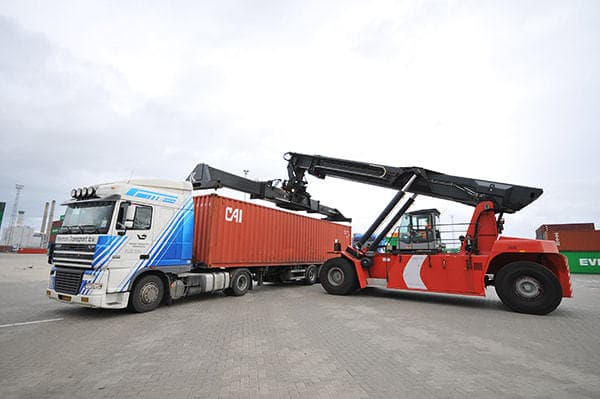
A well-prepared site matters for a storage container and a container home alike. When a container stands level and dry, its doors open easily, the floor stays dry and the container lasts for years. This article explains how to prepare the ground for a container and how delivery works.
How to choose the spot
- Level, firm ground. A container's weight rests on its four corners, so they must not sink.
- Drainage. Avoid a hollow where water collects after rain.
- Access. The truck must get close enough - the road has to be firm and wide enough for a heavy vehicle.
- Clear space above. There must be no power lines or low branches above the spot or the truck, because the container is lifted by crane.
- Door direction. Decide which way the doors should face so they can open fully and loading is easy.
Types of foundation
Concrete blocks
The simplest and most popular option. Blocks go under the container's corners, and for longer containers under the middle as well. The blocks must be levelled so the container does not twist.
Paving or a concrete slab
If the container will stay for a long time and vehicles will often come to it, a paved or concrete area is a good choice. It is level, strong and convenient.
Compacted gravel or crushed stone
A layer of compacted gravel or crushed stone drains water well and costs less than concrete. It must be compacted thoroughly so the base does not settle.
Screw piles
Container homes and saunas often sit on screw piles. They go in quickly, and the home stands above the ground, so air circulates underneath.
Why a container should not sit on bare ground
- moisture collects under the floor and the steel starts to rust;
- on soft ground the corners sink unevenly, the container twists and the doors stop closing properly;
- no air can circulate under the container, so more condensation forms.
How delivery works
We deliver containers across Latvia and the Baltics with the right equipment:
- Small crane truck for 10-20 ft containers: 6-7.5 m platform, 10-15 t lifting capacity, 9-12 m reach, unloading at the front or side.
- Large crane truck for 40-45 ft containers: 12-13.7 m platform, 17-21 t lifting capacity, 12-14 m reach.
- Side loader: a semi-trailer with two hydraulic lifts rated up to 32 t that sets the container down parallel to the truck about 1 m away.
- Telescopic semi-trailer for 20, 40 and 45 ft and special containers.
Thanks to the crane's reach, the container can often be placed behind a fence or between buildings. Read more under Transport services.
What to do on delivery day
- Mark the spot and prepare the base in advance.
- Make sure the access route is clear of cars and obstacles.
- Be there yourself, or ask someone to show the spot and the door direction.
- After placement, check the container and make sure the doors open properly.
Do you need a permit?
Whether placing a container needs approval depends on the municipality's rules, how the container is used and how long it will stay - especially if it becomes a home. If in doubt, ask the building authority (būvvalde) of your municipality.
Already know which container you need? See shipping containers for sale or container rental.